
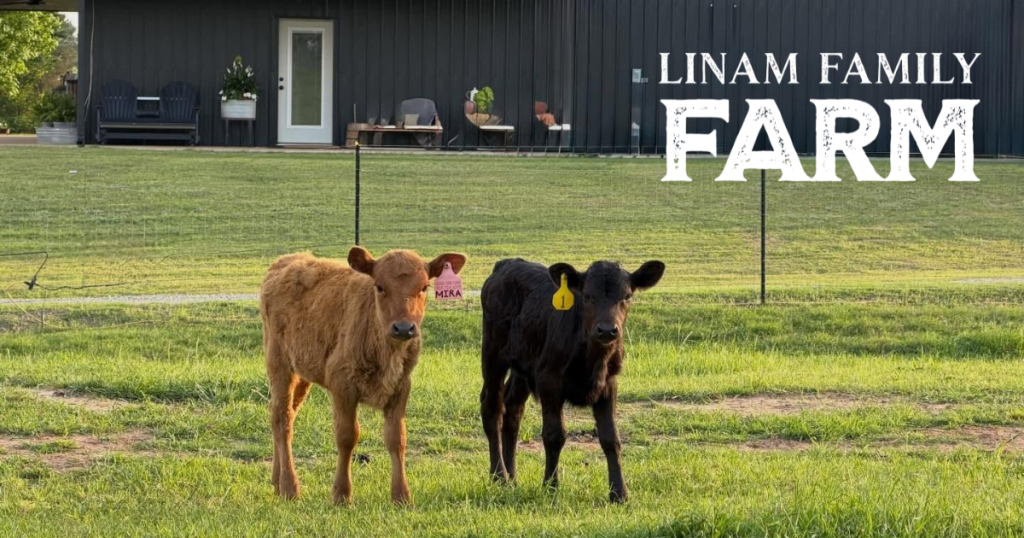
When people first spot the cows out in the pasture at Linam Farm, the reaction is usually something along the lines of: when did you get cows? And they are usually right behind that with: they are so small. And they are, compared to what most people picture when they think of cattle. But the Dexter breed is not small because something went wrong. They are small by design, and as it turns out, their size is the least interesting thing about them.
We brought our Dexter herd to Linam Farm with a very specific purpose in mind, and it is not the purpose most people guess. Yes, we will eventually have pasture-raised Dexter beef available in the store — the flavor and quality of Dexter meat is genuinely exceptional, and we are looking forward to offering it. But the reason we got cattle in the first place had everything to do with protecting our sheep, and it starts with a worm.
The Barber Pole Worm Problem
If you raise sheep in the South, you know about the barber pole worm. If you do not raise sheep, you probably have never heard of it, and that is fine — it is the kind of problem that lives entirely inside the world of livestock farming. But for sheep producers in Arkansas and across the humid South, Haemonchus contortus, the barber pole worm, is one of the most serious ongoing challenges in the business.
The barber pole worm is a blood-sucking internal parasite that lives in the digestive tract of sheep and goats. In high enough numbers, it causes anemia, weakness, and death. The worm thrives in warm, moist conditions — exactly the conditions that describe an Arkansas pasture through most of the year. Wet springs create ideal conditions for larval survival on grass. Drought stress lowers the animals’ natural resistance. The worm’s ability to develop resistance to chemical dewormers has made the problem increasingly difficult to manage through medication alone.
Last year was particularly hard for sheep farmers across our region. The conditions were right for a heavy parasite load, and producers who had relied on a single dewormer protocol found their treatments failing. It was a reminder that sustainable parasite management has to be built into the farming system itself, not bolted on top of it.
We had been watching this and thinking about solutions. The answer we landed on turned out to be grazing right alongside our sheep.
Why Cows Change the Equation
The insight behind using cattle to manage sheep parasite loads comes from the biology of the barber pole worm itself. The worm is host-specific in a meaningful way: it is highly adapted to small ruminants like sheep and goats and does not complete its life cycle effectively in cattle. When a cow grazes a pasture, it ingests the parasite larvae present on the grass — but those larvae cannot develop into reproducing adults inside a bovine digestive system. They essentially hit a dead end.
This means that cattle grazing the same pasture as sheep act as what our veterinarian, Dr. Quadros, describes as a biological vacuum for the parasite population. Every pass a cow makes through the grass picks up larvae that would otherwise remain on the pasture and be available for the sheep to ingest. Over a season, strategic co-grazing with cattle measurably reduces the worm burden on the pasture and, consequently, on the sheep.
This approach — running cattle and sheep together, sometimes called a “flirt” — has been studied and documented by agricultural researchers, including programs in the northeastern United States that have specifically investigated co-grazing as a parasite management strategy. For farms that want to reduce their reliance on chemical dewormers while improving overall flock health, it is a compelling and practical tool.
For us, it was the deciding factor. We needed a cattle breed that would work well in a mixed operation alongside our sheep, on our scale, with our land and resources. That search led us to the Dexter.
The Dexter Breed: Everything You Need to Know
Dexter cattle originated in Ireland and were developed specifically for small farms. They are the smallest of the standard cattle breeds — not miniature cattle in the sense of being a novelty or a scaled-down version of something else, but a fully developed, historically established breed whose compact size is one of its most valued traits.
A mature Dexter cow typically weighs between 600 and 700 pounds. A bull will run closer to 900 to 1,000 pounds. To put that in perspective, a mature Angus cow can weigh 1,200 to 1,400 pounds. Dexters are substantial animals — you would not want to step in front of one without paying attention — but they are manageable on a smaller farm in a way that larger breeds simply are not. They are easier on the pasture, require less feed per animal, and are known for being calm and docile in temperament.
Dexter cattle are a dual-purpose breed, meaning they were developed for both beef and dairy production. Their milk has a high butterfat content, and their beef is where things get genuinely interesting. Dexter beef is known for its fine marbling — a delicate, well-distributed fat pattern that produces tender, flavorful meat without the heavy fat deposits common in larger beef breeds. The flavor is rich and clean, and the smaller overall size of the animal means cuts are proportioned well for a family table rather than the industrial scale that larger breeds imply.
Gordon Ramsay has spoken publicly about his preference for Dexter beef on several occasions, citing the quality of the marbling and the depth of flavor compared to more commercially dominant breeds. When one of the most demanding palates in the culinary world singles out a cattle breed for praise, it is worth paying attention.
Our Herd at Linam Farm
We currently have one bull and five females, with two calves already on the ground. One of those calves was born right here on the farm — we were standing there when it happened, and it remains one of the more remarkable things we have witnessed in several years of farming. There is something about watching a calf find its legs in your own pasture that puts the whole enterprise in a different perspective.
Our brown heifer calf is named Mira, short for Miracle. She was born on one of the coldest nights in January at another farm before she came to us, cold enough that she needed warming and supplemental colostrum to get through her first hours. She is thriving now, full of energy and completely unbothered by the Arkansas heat that her previous night of cold seems like it happened to someone else.
The Dexter breed, beyond everything else, is simply a pleasure to have on the farm. They are curious animals. They come to the fence when you approach. They are photogenic in a way that feels almost unfair. Visitors this season are going to be able to see the herd from the farm while they are picking or shopping at the store, and we have a feeling the calves especially are going to make it very difficult for anyone to leave without stopping to take a picture.
What This Means for the Farm Long-Term
Adding cattle to Linam Farm was not a spontaneous decision. It was the result of thinking carefully about how to build a more resilient, integrated operation where the different elements of the farm support each other rather than existing in isolation.
The cattle manage the parasite load for the sheep. The sheep maintain the pasture at a height that benefits the cattle. The chickens follow behind both, scratching through the manure and spreading it, breaking pest cycles and contributing to soil health. The whole system is designed to work together, which means each individual component becomes more productive and more sustainable than it would be on its own.
This kind of integrated livestock management is not new — it is actually a return to how farming worked before industrial monoculture made everything about scale and separation. We are a small farm, and small farms have always done their best work by using what they have wisely and letting the natural relationships between animals, soil, and plants do some of the work for them.
Pasture-Raised Dexter Beef: Coming to the Store
As our herd grows and matures, pasture-raised Dexter beef will be available through the farm store. We are raising these animals the right way — on pasture, with room to move and graze, without the shortcuts that industrial beef production relies on. The result will be a product we are genuinely proud to put in front of our customers.
We already offer lamb from our Dorper sheep in the store, and the Dexter beef will be a natural complement. If you have had our lamb and appreciated knowing exactly where it came from and how it was raised, the beef is going to resonate with you for the same reasons.
We will announce availability through our social channels and in the store when cuts are ready. Stay tuned.
Come Meet the Herd
If you visit the farm this season, you will be able to see the cattle from the picking areas and the store. We ask that you enjoy them from a respectful distance — this is a working farm, not a petting zoo, and the animals are happiest when they can go about their day without feeling crowded by strangers. But watching a Dexter calf do what Tiffany has taken to calling “zoomies” across the pasture is genuinely one of the better things you will see on a summer morning in Arkansas.
Linam Farm is located at 7111 N Hwy 71 in Alma, Arkansas. Follow us on Facebook and Instagram for updates on the herd, the store, berry season schedules, and everything else happening out here.


