
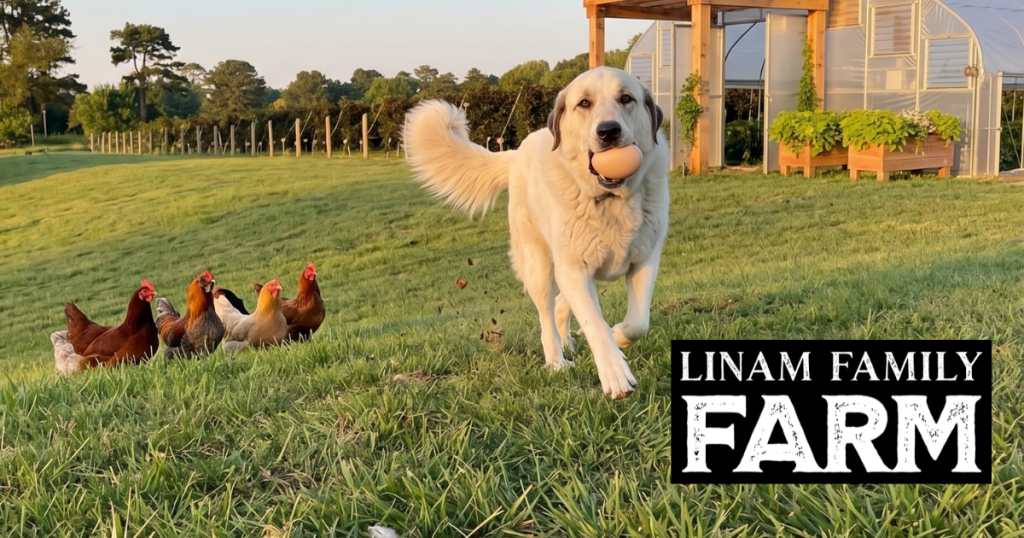
Every farm has its characters. The ones who show up reliably in every story you tell about the place, who have developed personalities so distinct that visitors ask about them by name, who somehow manage to be simultaneously very helpful and completely ridiculous at all times. At Linam Farm, those characters are Ranger and Mr. Squeakers, and both of them have had quite a spring.
We want to give you the full update, because if you have been to the farm in previous seasons, you already know these two, and if you have not, you are about to understand why people keep asking about them.
The Case of the Missing Eggs
We will start with Ranger, because his situation involves what can only be described as an ongoing investigation.
Ranger is our farm dog, a working dog in the truest sense — he is out in the fields every day, he knows the property better than most humans who have visited it, and he takes his responsibilities seriously. He is also, and this has become increasingly apparent over the past several weeks, a thief.
Here is what happened. Our laying hens have been free-ranging across the farm property for the past several months, and this has been wonderful for the soil, for pest management, and for the general energy of the place. Chickens that are allowed to roam follow a natural instinct to scratch through organic matter, disperse it, and forage for the insects and larvae living underneath. When they work through cow manure in the pasture, they are doing something genuinely beneficial: breaking it down, distributing it, and disrupting the pest cycle in ways that benefit the whole farm ecosystem. It is one of those natural synergies between animals that makes an integrated farm operation work better than any single-species approach.
The trade-off we did not fully account for is that free-ranging hens do not lay their eggs in neat, organized rows in the henhouse. They lay them wherever they feel like it, and their criteria for a good nesting spot bears no resemblance to what would be convenient for the humans collecting the eggs. Under hay bales. In the corner behind a post. Tucked into a gap in the equipment shed. In the tall grass at the edge of the pasture. Once, memorably, in a hollow in a grassy knoll that turned out to contain about 30 eggs that had been accumulating for what must have been quite a while.
Every afternoon has become an Easter egg hunt, and we are not always winning.
The evidence suggests Ranger is winning more often than we are.
The signs were gradual at first. His collar got a little snug. His silhouette from behind acquired a certain… amplitude. He had the look of a dog who was eating well and not particularly inclined to discuss the details. Then one afternoon, someone caught him in the act: moving purposefully toward a spot in the grass, returning with an egg held gently in his mouth — barely any pressure, just enough to carry it — and disappearing around the corner of the barn to a private location he has apparently designated for this specific activity.
He holds the egg. He barely cracks it. He licks it clean.
Raw eggs are, for what it is worth, genuinely nutritious for dogs. The protein, the fat, the biotin — dogs can absolutely benefit from raw eggs as an occasional treat. The emphasis there is on occasional. Ranger appears to have interpreted occasional as several times daily, which explains the collar situation and probably a fair amount of the self-satisfaction he projects at all times.
We have two options going forward. We can put the chickens back in the enclosed yard, which would restore egg inventory and protect Ranger’s waistline. Or we can get better at finding the eggs before he does, which would require us to think more like a chicken, which is its own kind of challenge. We are currently splitting the difference and hoping the egg hunt improves.
If you visit the farm and notice a somewhat rotund dog regarding you with the serene confidence of someone who has figured out the system, that is Ranger. He has indeed figured it out.
The Egg Situation by the Numbers
While we are on the subject of eggs, we should mention that our flock is producing at a genuinely impressive rate. On a good day, we are collecting 40 to 50 eggs. That is before accounting for Ranger’s independent operations.
For the first time, we are now selling farm-fresh eggs from the farm store. This is something we have wanted to do for a while, but the logistics of legally selling eggs require that they be washed and refrigerated, and until we had the commercial refrigerator in the new store, that was not something we could do in a compliant and consistent way. Now we can, and the eggs are available in the store throughout the season alongside our other products.
Farm-fresh eggs are genuinely different from commercially produced eggs, and we say that not as a marketing slogan but as a factual description that you can verify yourself if you crack one open next to a grocery store egg. The yolk is a deeper, more saturated orange-yellow. The white is firmer. The flavor is richer. These differences come from the diet and lifestyle of the bird — hens that range freely and eat a varied diet of insects, grass, and whatever else they find in a farm environment produce eggs with a different nutritional profile than hens raised in confined conditions on a uniform feed.
Our hens are outside every day, doing what chickens do. You can taste the difference.
A Note on What Chickens Do for the Farm
We have touched on this a bit, but it is worth spending a moment on because it genuinely informs how we manage the farm and why the free-range decision was made even knowing it would complicate the egg collection.
Chickens and cattle have a beneficial relationship that predates any deliberate farming strategy. In a natural grassland ecosystem, birds follow large grazers and feed on the insects and larvae in their manure. The birds benefit from the food source. The large animals benefit because the birds break the pest cycle — fly larvae, parasites, and other insects that breed in manure are disrupted and consumed before they can complete their life cycles and cause problems for the herd.
On a farm that is actively trying to reduce its chemical inputs and manage pests biologically, this relationship is a resource. Letting the chickens work through the pasture after the cattle have grazed it is not a messy compromise — it is a deliberate management decision that produces better soil, a healthier herd, and more pest control than anything we could spray.
Ranger’s side hustle is an unintended consequence of that decision, not a reason to reverse it.
Why the Farm Animals Matter to the Visitor Experience
We could tell these stories just because they are funny, and honestly that would be enough. But there is a real point underneath them that is worth making explicitly.
The animals at Linam Farm are not a backdrop or a prop. They are working members of a functioning agricultural ecosystem, and the relationships between them — the chickens and the cattle, the sheep in the pasture, Ranger working the perimeter, Mr. Squeakers keeping order in the yard — are what make this a real farm rather than a berry-picking lot with some decorative animals near the entrance.
When visitors come to Linam Farm and see these things happening, it teaches something that no amount of reading about local agriculture can teach. You see where eggs actually come from. You see how different animals support each other in ways that make the whole operation more efficient and more sustainable. You see the humor and the reality and the occasional chaos of farming up close, and it changes how you think about the food on your table.
That is one of the reasons we welcome families with children especially warmly. Kids who visit a working farm carry that experience with them. They become adults who care about where their food comes from and who understand that the people growing it are doing something worth supporting.
What to Expect When You Visit
When you come to Linam Farm this season, you will likely see Ranger at some point during your visit. He is usually working the property, often in the vicinity of anywhere eggs might plausibly be hidden. If he regards you with the calm confidence of someone who has nothing to prove, that is normal for him.
The cattle will be in the pasture, visible from the picking areas and the store. The sheep will be doing whatever sheep do, which is generally grazing and looking photogenic. The chickens will be everywhere, in the way that free-ranging chickens always are, and if you happen to spot an egg in an unexpected location, we would genuinely appreciate you letting us know before Ranger gets to it.
Linam Farm is located at 7111 N Hwy 71 in Alma, Arkansas. Follow us on Facebook and Instagram for updates, animal photos, and real-time information on picking schedules and store hours throughout the season. We post the egg hunt findings when they are particularly ridiculous, which is fairly often.


